

Smart Shelf
A modular, retrofittable shelf scale for automatic inventory tracking: stock levels and withdrawals are captured where they happen — at the shelf position, with no stocktake and no manual booking.
Status
In development — pilot projects and individual enquiries welcome.
 Concept rendering
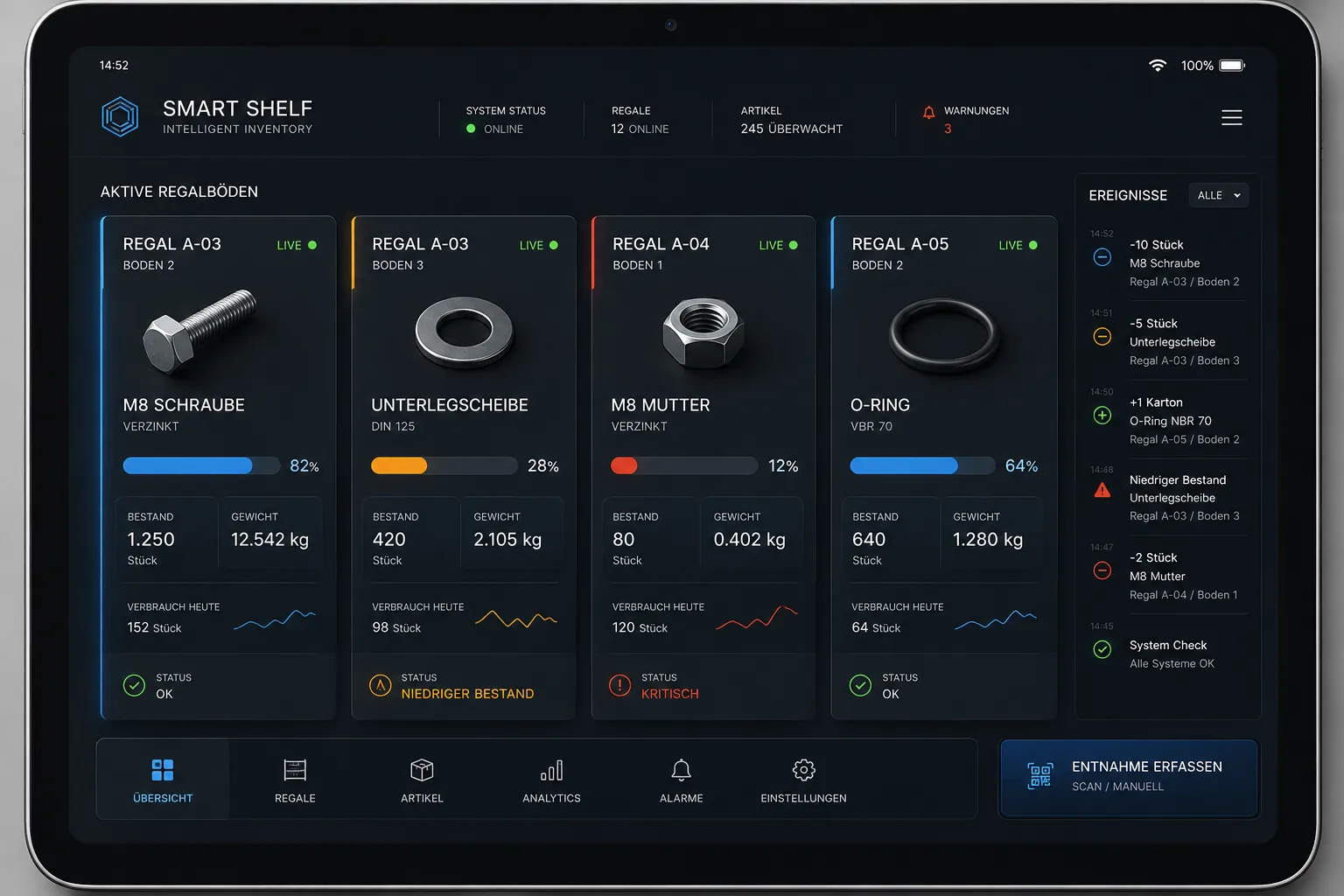
The interface as it is intended
Per shelf: the stock level, the measured weight and the day's consumption; on the right, events in the order they occurred. The figures in the image are invented — they show the shape of the display, not a real stock level.
 Concept rendering
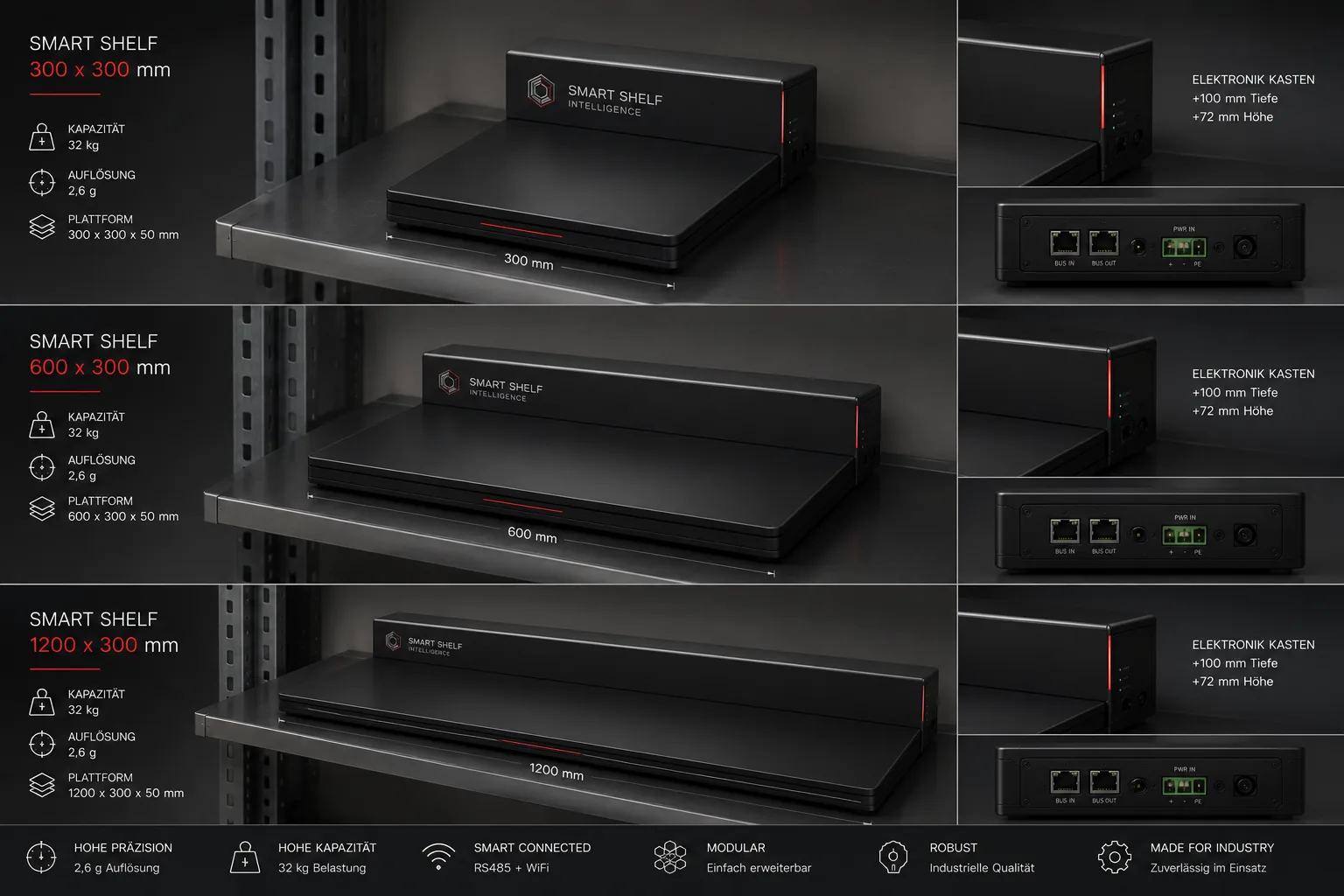
The three platform sizes in a shelving unit
Each platform sits on an existing shelf board. On the right, the electronics enclosure with bus in, bus out and power — it is the reason several boards can be chained into one run.
The problem
The stock is in the system, not on the shelf
Consumables, C-parts and semi-finished goods get taken without anyone booking them out. The stock level in the ERP is then only roughly right until the next stocktake — and the reorder comes either too early or too late.
Barcode scanners and withdrawal lists only solve this as long as everybody uses them. A scale under the shelf asks nobody.
The development approach
- A shelf scale per position instead of counting by hand
- Local data processing and web interface
- Possible connection to ERP systems
- Robust architecture with as little hardware as possible
- Communication planned over RS485 and a central edge controller
The principle
From the withdrawal to the warehouse system
Four steps, three of which run without anyone involved. Only the step that turns grams into a piece count may need to ask a question — and that is exactly where it is decided how well the system fits a given store.
- 01
The shelf weighs, continuously
Load cells sit beneath every platform. They do not measure on demand but continuously — a change in weight therefore becomes an event within seconds, not the result of a counting round.
- 02
A controller evaluates
All boards hang off an RS485 bus connected to an edge controller. It tells a withdrawal from a return, spots a minimum level being crossed, and does its computing where the scales are — not in a cloud.
- 03
Grams become a piece count
The quantity follows from the change in weight and the stored unit weight. Where the result sits between two plausible counts, the system asks rather than guesses — a wrong booking costs more than a question.
- 04
The stock level moves on
The level is handed to the system that keeps it anyway — ERP, warehouse management or a database. Smart Shelf is meant to supply the figures, not to open a second stock system alongside the first.
The decision
Why weight rather than barcode or RFID
Barcode and RFID identify a part. That is more precise — and it requires someone to scan, or every single part to carry a tag. For a box of 1,250 M8 bolts, neither is practical.
A scale measures instead of identifying. It asks for no extra handling, and it notices the withdrawal someone makes in a hurry along the way. What falls away:
- Tags on every individual part
- A scan at every withdrawal
- Manual bookings
- One more step somebody can forget
And the price for it
The system sees weight, not identity. It registers that 26 grams are missing — which part that was follows from what lies in the compartment. For a compartment holding one article that is unambiguous; for one holding five articles of similar weight it is not. Which is precisely why Smart Shelf suits single-article compartments first.
Modules
Three sizes that combine
Three platforms are planned, each laid onto an existing shelf board. Several of them can be chained into one unit; the storage layout stays as it is. Retrofitting should not mean replacing the shelving.
Platform design figures
- 32 kg
- Load capacity per module
- 2.6 g
- Load cell resolution
- 50 mm
- Platform height
- +100 / +72 mm
- Electronics enclosure, depth and height
Architecture
The scales are not on the company network
The weighing electronics run on their own segment and cannot be reached from the company network. The edge controller sits between them as the only link — whatever reaches the company network goes through it and through nothing else.
That is not red tape but the condition for an IT department agreeing to any of this. A shelf board is a device that stands unnoticed in a hall for years; giving it a place on the company network would be a door nobody keeps an eye on.
Integration
A stock level is only worth something where the ordering happens anyway. Smart Shelf is therefore intended as a supplier of data, not as one more screen somebody has to check. Planned are:
Planned means planned. Which of these paths end up finished will be decided by the systems of the first pilot users — none of them is signed off today.
Where for
Where it should pay off
Most likely where many identical parts are consumed quickly and a manual booking is therefore regularly skipped:
- Production supply and kanban shelving
- C-parts management
- Spare parts stores
- Assembly workstations
- Chemicals and adhesives
- Laboratory supplies
Optional
AI as an addition, not as the foundation
For compartments holding several similar articles, or for forecasting consumption, an AI evaluation can help. Conceivable are automatic article assignment, camera-based recognition, consumption forecasts and a flag on unusual patterns.
- Automatic article assignment
- Camera-based withdrawal recognition
- Consumption forecasts
- A flag on unusual patterns
- Reordering suggestions
Open
What is not settled yet
These points are the reason there is no data sheet here yet. Naming them honestly is worth more in a pilot project than a figure that does not hold up later.
Accuracy of the piece count
The cell resolution is stated above. How reliably a piece count follows from it depends on the setup, the compartment size and the part weight — there are no committed figures for that yet.
Delivery dates
There is no series production date. Schedules are set within the pilot project, together with the company involved.
ERP connection
Planned, but not finished. Whether and how it works depends on the interface of the system in question — that is reviewed beforehand.
Pilot project
What working together looks like
A pilot starts with a single shelf unit and a manageable number of compartments. Out of it comes what is missing today: reliable figures for your material mix and your setup.
What you bring is access to the shelf, a contact person and the willingness to evaluate the result. What you get is a system specified for your parts rather than for a brochure figure.
Interested in a pilot?
Describe your shelving and the parts on it.
Compartment sizes, rough part weights and how withdrawals are booked today — that is all it takes for a first assessment.